
This tutorial will show you how to strum a guitar, with strumming patterns to practice and learn.
Basic strumming is fundamental to playing a guitar and I have found that most people need to be taught how to strum correctly.
The following strumming patterns will show you the basics of how to strum guitar and set you on the right path.
Your strumming arm is like the drummer in a band - it keeps time. You need to be able to move it up and down in strict time with a metronome. If it never pauses, speeds up, or slows down ~ you're on the right track.
Practice with a metronome, drum machine, backing track or favourite CD, until you are confident that you can move your arm up and down perfectly in time with the music without touching the strings of your instrument, or playing a rhythm on your strings whilst having your left hand gently laid across them.
There are several free metronome programs available on the net. Just Google 'free metronome'. Download one now, to use whilst working through this page.
Now practice this first strumming pattern with any chord of your choosing:
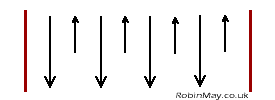
Strumming patterns are like a loop - when you reach the end, continue from the beginning. Do not pause as you strum - move seamlessly from the end of the strumming pattern straight back into the beginning.
Pattern one is a basic pattern that is one bar in length. Count it in your head as 1 & 2 & 3 & 4 &, with each 'up' being an '&'.
The arrows represent your right arm going up and down. Where the arrow is long, strum the guitar strings. Where the arrow is short, miss the strings - but still move your arm.
This is fundamental to being able to play in time - whilst learning to strum you should always keep your arm moving in time. Generally speaking, we strum from our elbow during slower patterns and more from our wrist for a fast tempo. I suggest you begin from the elbow, at a gentle pace. As with so many things, it is best to get it perfectly correct at a slow pace and then speed up the tempo.
If you find your arm pausing at any time - you're doing it wrong (well...it's a rule of thumb).
Always practice your strumming with a metronome or drum-beat.
Once you are completely comfortable with this most basic rhythm, go through each of the following strumming patterns. I encourage you to master each prior to moving on to the next.
This next one probably sounds best with a barre chord, and gives you the opportunity to develop left hand dampening - release pressure with your left hand (but don't stop touching the strings) whenever you're not striking the strings (i.e. during the little arrows).
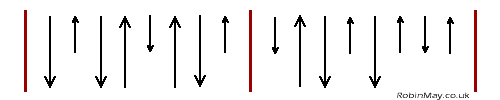
This last one also demonstrates the importance of keeping your right-hand moving even when you're not strumming the strings. If you let your arm stop at the end of this pattern, even though there are three short arrows, you're likely to lose the timing.
By now you'll be getting the idea - so try making some patterns of your own. Simply draw any combination of short and long arrows, with eight for each bar, and alternating between up and down arrows - beginning with a down arrow.
These examples are using eighth beats = eight arrows to the bar. Try 16th beats, which will involve your arm going twice as many times per beat = sixteen arrows to the bar. As a general rule: Strum from your wrist, rather than your elbow, when strumming 16th beats.
< Back to all posts
Basic strumming is fundamental to playing a guitar and I have found that most people need to be taught how to strum correctly.
The following strumming patterns will show you the basics of how to strum guitar and set you on the right path.
Your strumming arm is like the drummer in a band - it keeps time. You need to be able to move it up and down in strict time with a metronome. If it never pauses, speeds up, or slows down ~ you're on the right track.
Practice with a metronome, drum machine, backing track or favourite CD, until you are confident that you can move your arm up and down perfectly in time with the music without touching the strings of your instrument, or playing a rhythm on your strings whilst having your left hand gently laid across them.
There are several free metronome programs available on the net. Just Google 'free metronome'. Download one now, to use whilst working through this page.
Now practice this first strumming pattern with any chord of your choosing:
Strumming patterns are like a loop - when you reach the end, continue from the beginning. Do not pause as you strum - move seamlessly from the end of the strumming pattern straight back into the beginning.
Pattern one is a basic pattern that is one bar in length. Count it in your head as 1 & 2 & 3 & 4 &, with each 'up' being an '&'.
The arrows represent your right arm going up and down. Where the arrow is long, strum the guitar strings. Where the arrow is short, miss the strings - but still move your arm.
This is fundamental to being able to play in time - whilst learning to strum you should always keep your arm moving in time. Generally speaking, we strum from our elbow during slower patterns and more from our wrist for a fast tempo. I suggest you begin from the elbow, at a gentle pace. As with so many things, it is best to get it perfectly correct at a slow pace and then speed up the tempo.
If you find your arm pausing at any time - you're doing it wrong (well...it's a rule of thumb).
Always practice your strumming with a metronome or drum-beat.
Once you are completely comfortable with this most basic rhythm, go through each of the following strumming patterns. I encourage you to master each prior to moving on to the next.
 |  |
 |  |
This next one probably sounds best with a barre chord, and gives you the opportunity to develop left hand dampening - release pressure with your left hand (but don't stop touching the strings) whenever you're not striking the strings (i.e. during the little arrows).
This last one also demonstrates the importance of keeping your right-hand moving even when you're not strumming the strings. If you let your arm stop at the end of this pattern, even though there are three short arrows, you're likely to lose the timing.
By now you'll be getting the idea - so try making some patterns of your own. Simply draw any combination of short and long arrows, with eight for each bar, and alternating between up and down arrows - beginning with a down arrow.
These examples are using eighth beats = eight arrows to the bar. Try 16th beats, which will involve your arm going twice as many times per beat = sixteen arrows to the bar. As a general rule: Strum from your wrist, rather than your elbow, when strumming 16th beats.
< Back to all posts